
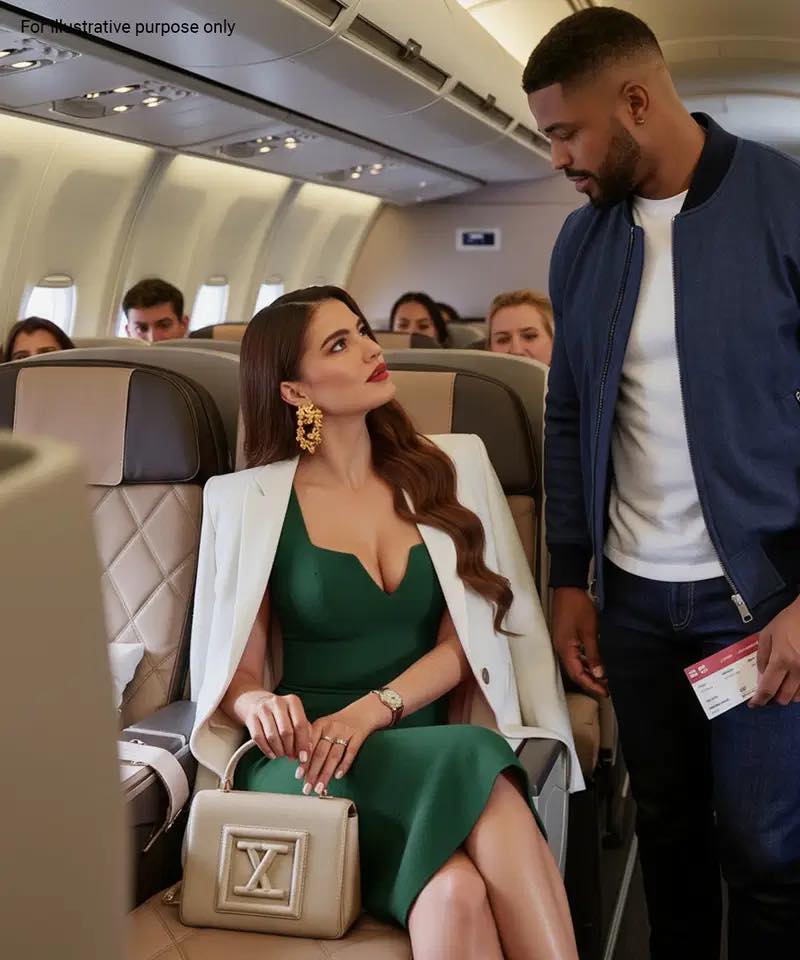
Karen examined her manicured nails. “I can’t believe this is even a discussion. Look at us. Look at him. It’s obvious who belongs where.”
Marcus’s jaw tightened almost imperceptibly. His breathing remained steady, controlled. Years of meditation and executive training kept his composure intact.
“Eight minutes to departure.” The captain’s voice crackled over the intercom.
Sarah turned to Karen. “Ma’am, I apologize for this delay. We’ll have this resolved immediately.” She pressed the call button for the purser. “David, I need assistance in first class. We have a passenger in the wrong seat who won’t comply.”
Marcus observed the exchange with detached curiosity. Every word and movement was being captured from several angles. The coverage was flawless. Amy’s livestream had drawn in three thousand viewers. Her hushed narration caught it all: The flight attendant won’t even glance at his boarding pass. This is unreal.
“I’ve seen this before,” Karen announced to nearby passengers. “People buy one expensive item and think it proves everything.” She gestured at Marcus’s clothes. “Designer hoodie? Please.”
Marcus said nothing. His silence seemed to irritate Karen more than arguments would have.
“At least say something,” she taunted. “Defend yourself—unless you know you’re wrong.”
The purser’s footsteps approached from behind. David Torres, eight-year Delta veteran, carried himself with practiced authority. His eyes immediately assessed the situation: well-dressed woman in first class, casually dressed man standing in the aisle. The mental math was simple.
“What seems to be the problem here?” David’s voice carried the weight of policy and procedure.
“This passenger,” Sarah emphasized the word like an accusation, “refuses to move to his assigned seat. He’s disrupting our departure schedule.”
David didn’t ask to see Marcus’s ticket. Didn’t ask for his name or confirmation number. The assumption was instant and complete.
“Sir, you need to find your correct seat immediately. We have a schedule to maintain.”
Marcus extended his boarding pass again. “I am in my correct seat. This is my documentation.”
David barely glanced at the paper. “Sir, I don’t have time for fake documents or games. Move to economy now or I’ll call airport security.”
Several passengers gasped. Amy’s viewer count jumped to five thousand. Marcus looked around the cabin. Every face told the same story: they saw his appearance and made their judgment. The boarding pass in his hand might as well have been invisible.
“Six minutes to departure,” came another announcement.
“Perfect,” Karen said, settling deeper into the seat. “I have a connecting flight in New York. I can’t afford delays because of this nonsense.”
Marcus nodded slowly as if coming to a decision. He pulled out his phone and opened an app. The loading screen showed a Delta Air Lines logo.
“What’s he doing now?” Sarah muttered to David.
“Probably calling someone to complain,” David replied dismissively. “People always do.”
Marcus’s thumb moved across the screen, navigating through menus with practiced efficiency. His expression remained calm, almost serene. The storm was about to break.
“We have a code yellow in first class,” David spoke into his radio, requesting additional crew support. Within seconds, two more flight attendants appeared—James Mitchell, twenty-five, fresh-faced and eager to impress, and Michelle Rodriguez, forty, a veteran with tired eyes and zero patience for disruptions.
“What’s the situation?” Michelle asked, crossing her arms as she looked Marcus up and down.
“The passenger refuses to move to economy,” Sarah explained. “Won’t accept that he’s in the wrong seat.”
James positioned himself behind Marcus, blocking any retreat. “Sir, we really need you to cooperate here.”
Four crew members now formed a semicircle around Marcus in the narrow aisle. Karen watched from her stolen throne, a satisfied smile playing on her lips.
“This is embarrassing,” she announced loudly. “I’m trying to get to an important business meeting, and this man is holding up the entire flight with his story.”
Marcus remained calm, his phone still in his hand. The Delta app was open, but the screen wasn’t visible to the crew.
“Five minutes to departure.” The captain’s voice cut through the tension. “Crew, please prepare for pushback.”
“You hear that?” David’s voice hardened. “You’re delaying two hundred passengers because you can’t accept reality.”
“Yeah,” James added, emboldened by the group dynamic. “Just take your real seat and we can all move on.”
Michelle stepped closer, her voice dropping to a threatening whisper. “Listen carefully. Move to economy now, or airport security will remove you. Your choice.”
The threat sent a ripple through the cabin. More phones appeared. Amy’s TikTok stream exploded to fifteen thousand viewers. Comments flew: Call the police. This is 2025. File a complaint.
Karen basked in the attention. “I’ve never seen such entitled behavior. Some people think the rules don’t apply to them.” She turned to address the filming passengers. “You’re all witnesses to this disruption. I tried to handle this quietly, but he just won’t listen to reason.”
A businessman in seat 2C lowered his laptop. “Excuse me, but shouldn’t you at least look at his boarding pass first?”
“Sir, please don’t interfere,” David cut him off sharply. “We’re handling this professionally.”
“Professionally?” The businessman’s eyebrows rose. “You haven’t even verified his ticket.”
Michelle whirled around. “Are you questioning our procedures?”
“I’m questioning why you won’t look at a piece of paper,” the man replied evenly.
Sarah’s face flushed. “We don’t need to examine obvious forgeries.”
“How do you know it’s forged if you haven’t looked?” asked an elderly woman in 1B.
The crew was losing control of the narrative. Passengers were turning against them, and the phones kept recording.
“Look at him,” Karen said, standing from the seat and gesturing widely. “Use your eyes. Does anything about this man say ‘first-class passenger’ to you?” She pointed at Marcus’s hoodie. “That’s a $30 sweatshirt from a big-box store. I can tell.”
Marcus glanced down at his clothing, then back at Karen with mild curiosity. “How can you determine the price of my clothes?”
“Because I know quality when I see it,” Karen snapped. “Your shoes are probably discount. Your jeans look like they came from a warehouse bin.”
“Ma’am is absolutely right,” James nodded eagerly. “First-class passengers have certain presentation standards.”
Michelle crossed her arms. “We’re trained to identify passengers who might be out of place. It’s about maintaining the premium experience for legitimate customers.”
Marcus’s phone buzzed with notifications—text messages, missed calls, emails marked urgent. One message preview was visible: Board meeting moved to 4:00 p.m. Karen spotted it and laughed. “Oh, look. He’s got someone texting him about a board meeting. How cute.”
Several passengers shifted uncomfortably at the cruelty, but the crew seemed energized by Karen’s confidence.
“Sir,” David said, patience evaporated, “this is your final warning. Security is already on their way up the jet bridge.”
“Actually,” Marcus said quietly, “I’d like them to see this.”
His calm response seemed to unnerve the crew. They’d expected anger, arguments, threats of lawsuits. Instead, he stood there like he was collecting evidence.
“See what?” Sarah snapped. “Are you making a fool of yourself?”
“Him proving he doesn’t belong here?” Karen added with a laugh. “Look at him. Really look.”
A teenage passenger whispered loudly, “This is so wrong. They won’t even look at his ticket.”
James spun around. “Excuse me? We’re following standard protocols here.”
“Then why won’t you look at his ticket?” the teenager shot back.
“Because we can tell when someone’s not being truthful,” Michelle replied coolly. “It’s called experience.”
Marcus glanced down at his comfortable walking shoes, then back at Karen. Still no anger in his expression. If anything, he looked satisfied.
“Ma’am has a point,” Michelle said. “First-class passengers dress appropriately. They understand the environment they’re entering.”
“Exactly,” James nodded. “It’s about respect—respect for the airline, for other passengers, for the premium experience.”
Amy whispered to her live stream, “They won’t even look at his ticket.” Her viewer count hit twenty-five thousand. A trending tag on social media began to spike.
David keyed his radio again. “Security, what’s your ETA to gate A12?”
“Two minutes out,” came the crackling response.
“Perfect.” Karen clapped her hands together. “Finally, some professional handling of this situation.” She looked directly at Marcus. “I hope you’re happy with yourself. Now everyone on this plane knows exactly what kind of person you are.”
Marcus tilted his head slightly. “What kind of person am I?”
The question caught Karen off guard. She’d expected denial, not curiosity.
“You’re the kind who tries to take what isn’t yours,” she said, regaining her composure. “Who thinks you can fool people with papers and stories.”
“I haven’t told any stories,” Marcus observed quietly.
“Your whole presence here is a story,” Karen shot back. “A fantasy where you belong in first class. Well, reality is about to knock.”
The crew nodded in agreement. They’d created a unified narrative: Marcus was a problem; they were the guardians of order.
Heavy footsteps echoed from the jet bridge. Two airport security officers appeared at the aircraft door, radios crackling with status updates.
“There he is,” Sarah said, pointing at Marcus. “The passenger causing the disruption.”
Officer Williams, a Black man in his forties, approached with his partner, Officer Carter, an Asian American woman with kind eyes but firm demeanor—both in standard U.S. airport police uniforms. “What seems to be the problem here?” Officer Williams asked professionally.
David launched into his prepared explanation. “The passenger refuses to move to his assigned seat. Claims this first-class seat belongs to him despite obvious evidence to the contrary.”
“What obvious evidence?” Officer Carter asked.
więcej na następnej stronie
